The Sailing Vessel
“Duifken””
Welcome to ....
ossmaritime.como
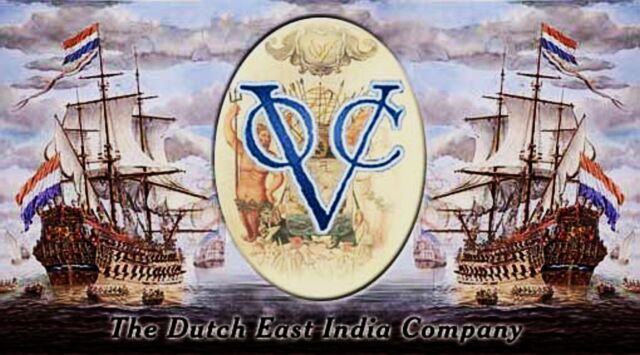
“Dutch East India Company”.
“Vereenigde Oost-Indische Compagnie” - “VOC”.
The VOC Company and the “Duifken” story.
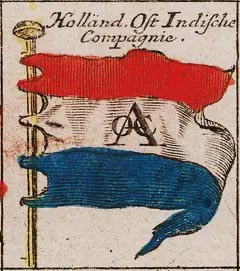
Original “VOC” flag.
The Dutch vessel the “Duifken” for in the Netherlands she was according to all the Dutch, she was simply “Duifje” (simply meaning ‘Little Dove’). But for whatever reason internationally she has become “Duifken”. The simple point is that in the Dutch language there is No Y, for it is written as follows in Dutch; ‘ij’ or ‘IJ’.
The “Duifken” was a small sailing vessel and she was constructed in what was then known as the *Dutch Republic.
*The “Dutch Republic” was originally known as the “United Provinces of the Netherlands”, being a confederation that existed from 1579 until the Batavian Revolution in 1795. It was a predecessor state of the present-day Netherlands and the first independent Dutch nation state. The republic was established after seven Dutch provinces in the Spanish Netherlands revolted against Spanish rule, forming a mutual alliance against Spain in 1579, known as the “Union of Utrecht” and declaring their independence in 1581 (the Act of Abjuration).
For a small ship she was a well built vessel and she proved to be fast for her day. She was 49 to 59 tons, or 108–130 thousand pounds, etc.
The “Duifken” was armed with cannons for protection, and she had facilities to carry valuable cargoes, etc. Sadly we do not have concrete dates of her launching or when she departed on her first voyage to the “East Indies”, being today’s Indonesia.
However later in 1595, the “Duifken” departed for her first expedition to Bantam. After returning in August 1597, she was renamed “Overijssel” and she sailed on the second (1598) as well as the fourth expedition to the East Indies.
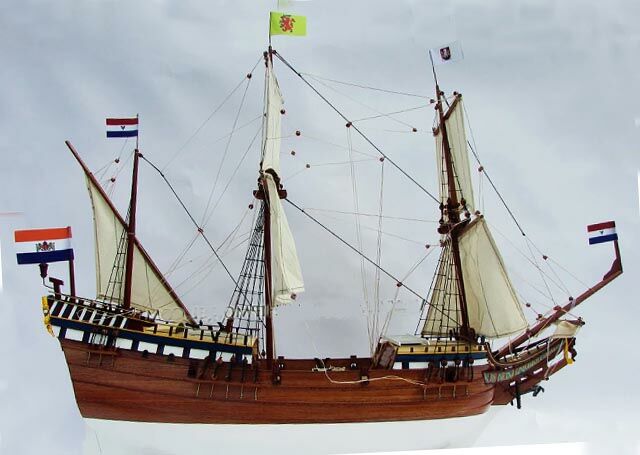
A view of the Duifken model
The question remains, however what was the Duifken doing between 1597 and 1601? It is inconceivable that the prudent Dutch would waste a vessel which had proved to be such a great and an seaworthy vessel that had a proven record and being suitable for long world voyages. Besides, they refitted and sent out the other two vessels which had returned. We seem to have found a partial answer in the statement that the Duifken was renamed the ‘Overijssel’ for her second voyage to the East Indies. But, in the best account of that voyage, we find the contradictory statements (1) that the ‘Overyssel’ was the former Duifken, and (2) that the vessel had the same specifications. As well as she took precisely men on the ‘Overijssel’ as did the Duifken, the final proof being that she carried an armament of two large and six small guns, as well as the very same four stone-slingers. Thus every single fact proves that the ‘Duifken’ and ‘Overijssel’ were the very same vessel.
This second fleet, departed on May 01, 1598, under the command of Admiral van Neck, and the fleet comprised eight vessels, including the ‘Mauritius’ and the ‘Hollandia’ of the first fleet, a new vessel sailed from Amsterdam, and five other ships that were named after provinces of the Netherlands: ‘Zeelandia’, ‘Geldria’, ‘Utrecht’, ‘Vriesland’ and a smaller ship named the ‘Overyssel’, and I have it from the most reliable source in the Netherlands’, that it was indeed the very same ship as the ex ‘Duifken’.
However, thereafter in 1606, she was picked to
depart on another voyage of discovery, and in March 1606, with the ship now being under the command of Captain ‘Willem Janszoon’, and first officer ‘Jan Roosengijn’, as well as 18 other crew, the ‘Duifken’ departed headed for Banda
(Jaca), but soon after they set off on
another long voyage to further explore unknown territories to the east and
south seeking out potential of further trade opportunities. They visited
the ‘Kei Islands’, then along the south coast of New Guinea,
skirting south of the shallow waters around ‘False Cape’ and then
continuing east-southeast until they reach and chart the shores of
Australia's Cape York Peninsula. Landfall was made at
the mouth of the ‘Pennefather River’ in
the ‘Gulf of Carpentaria’.
However, Captain Janszoon then sailed down and charted over 300 km of the west coast of Cape York peninsula and they sailed south as far as “Cape Keerweer”, where he met up with local Aboriginal people. At first a fight commenced, and several of the crew were killed. The captain decided that this new land had no spices or anything worthwhile, thus he turned around his ship at this point, and retraced his voyage back to Banda.
No matter what, the sailors of the “Duifken” were the very first Europeans to visit and stand on the Australian continent, they were the first to chart any of its coastline, and the first to make contact with the indigenous people of Australia the Aboriginal's. Captain ‘Willem Janszoon’s “discovery” of Australia took place a good 164 years before James Cook’s arrival at Botany Bay in 1770.
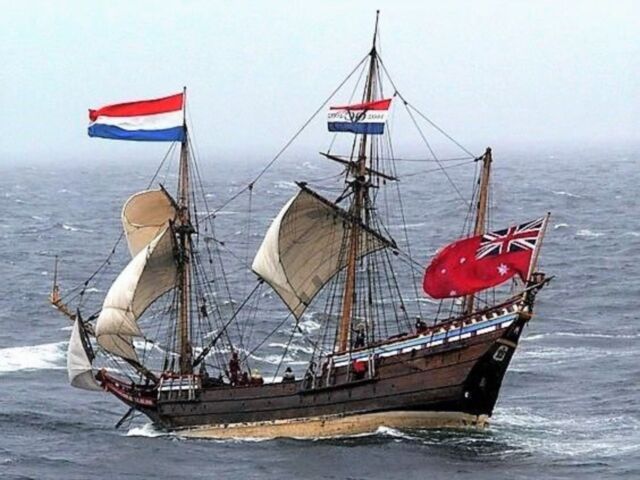
The reconstructed version of the Duyfken is
seen arriving in Australia for the "Astralian Day" celebration.
Duifken may have made a second voyage east to Australia. Later in the year she is sent to Java to get supplies for the beleaguered “Dutch fortress” on Ternate.
Sadly at sometime later, in 1608, the ‘Duifken’ had suffered some damage to her hull and due to the repair company having made a dreadful mistake placing her on her side, to repair the bottom part of her hull, however this brought about the end of the famous sailing vessel, the beautiful and faithful “Duifken”.
There is no doubt that
the “Duifken” was not really one of the most famous ships of the “Dutch East
Indies” VOC fleet, but she was intended just to be a scout and a support
vessel for the trading fleets working on the spice trade in the “East
Indies”.
Although, with her
being relatively small, with just a 110-tonne displacement, being 20 m in
length and her 6 m beam. She had three fine masts, and she was well armed with
two small, and six cannons. For a sailing vessel of those days, she was fast
and manoeuvrable. Stationed in Banda (today the Indonesian province of Maluku),
Duifken’s role was exploration, finding new
resources of the valuable spices abounding in these multitudinous islands and
surveying and charting the most profitable trading routes.
The “Duifken” days ended in 1608, as was told above. No matter what, this was a small vessel that made history world wide!
Basic Specifications:.
Name: Duifken.
Launched in: 1595.
Displacement tonnage: 110 tons.
Length: 65.4 ft - 19.9 m.
Beam: 19.7 ft - 6.0 m.
Draft: 8 ft - 2.4 m.
Propulsion: Sails.
Speed: 7 knots 13 km/h or 8.1 mph.
Crew: 20 men.
Armed with: 2 small, and 6 large
cannons.
First voyage: 1596.
Fate: Condemned beyond repair on July 1608 at ‘Ternate’ Indonesia.
*********************
“Blue Water Liners sailing to the
distant shores.
I watched them come, I watched them go and I watched them die.”
Featuring well over 1,750+ Classic Passenger
Liners, Passenger-Cargo Liners & Classic Cruise Ships!
ENTER HERE
Amazingly; ssmaritime.com
has received 7.57 billion visitors to date
Last update: January 24, 1922
For interest: Sadly an email
service to ssMaritime is no longer available, due to the author’s old age
and chronic illness as well as being disabled, etc. In the past ssMaritime
received well over 120 emails per day, but Mr. Goossens can no longer handle
same. He sincerely regrets this!
*********************
Where the ships of the past make history:
The Author has been in Passenger Shipping & the Cruise
Industry since 1960.
In addition he was the founder of ex “Save the
Classic Liners Campaign” in 1990.
Please Note: ssmaritime and associated sites are 100% non-commercial
and the author seeks no funding or favours
of any shape or form, never have and never will!
Photographs on ssmaritime and associate pages are by; the author or from the
author’s private collection. In addition there are some images that have
been provided by Shipping Companies and private photographers or collectors.
Credit is given to all contributors. However, there are some photographs
provided to me without details regarding the photographer/owner concerned.
This notice covers all pages; although, and I have done my best to ensure that all
photographs are duly credited and that this notice is displaced on each page,
that is, when a page is updated!
ssMaritime is owned & © Copyright by Dr.
Reuben Goossens - All Rights Reserved